
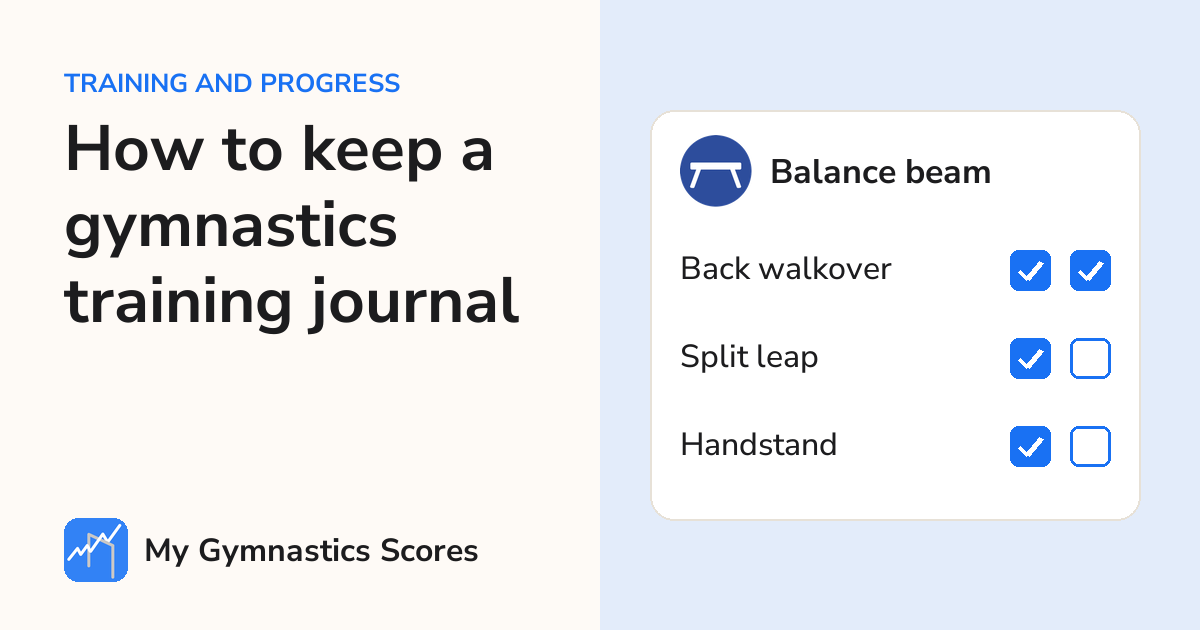
A gymnastics training journal is a simple record of the skills a gymnast is learning, the goals she is working towards, and the small things the coach says that make a skill click. It takes a few minutes after training, and it turns months of hard work into progress you can see. This guide explains what to write in a gymnastics journal, how to track skills from “first time” to “consistent”, and how to keep the habit going.
Why keep a gymnastics training journal?
Gymnastics progress is slow and uneven. A skill can take weeks to land for the first time and months to become reliable. Without a record, it is easy to forget how far you have come, especially in a season when competition scores are flat.
A journal helps in three ways:
- It shows progress between competitions. Skills improve long before scores do.
- It keeps the coach’s tips. A correction written down after training is easier to remember next week.
- It builds good goals. Research on goal setting in sport found that process goals, about how a skill is done, gave much bigger gains than outcome goals, about results. A journal is where process goals live.
What to write in a gymnastics journal
Keep one page, or one section, for each apparatus. Then write down four things.
1. A goal for the apparatus
One clear goal for the next few months, in the gymnast’s own words. Good goals are about skills and form, not places or medals. For example:
- “Clean back walkover and a stuck dismount” on beam.
- “Kip on my own” on bars.
- “Land my round-off back handspring without a step” on floor.
2. The skills you are learning
List each skill by name. Keep the list short: the skills that matter this season, not every skill you know.
3. Two dates for each skill
This is the most useful part. For each skill, record:
- First time done properly: the date the gymnast first did the skill correctly, with good form, not just survived it.
- Consistency achieved: the date the gymnast can do it correctly almost every time, the point where the coach would put it in a routine.
The gap between the two dates tells the real story of learning. It also shows why patience matters: a skill that took six weeks to become consistent is a big achievement, even if it never appeared in a competition.
4. Points to remember
One or two short notes per skill, such as “push through the shoulders” or “eyes on the end of the beam”. Keep them short, so they are easy to read before training.
An example journal page
| Goal/skill | First time done properly | Consistency achieved | Notes |
|---|---|---|---|
| Back walkover | 4 Jun 2026 | 20 Aug 2026 | Push through the shoulders |
| Split leap | 2 Jul 2026 | Full split, hold the landing | |
| Cartwheel to handstand | 15 Sep 2026 |
How to keep the habit going
- Keep it short. Two minutes after training is enough. A journal that takes half an hour will not last a season.
- Let the gymnast own it. Parents can help younger gymnasts, but the goals and notes should be the gymnast’s own words.
- Look back once a month. Count the skills that moved to “consistent”. That is the progress to celebrate.
- Link it with scores. When a skill becomes consistent, watch the E-score on that apparatus at the next competitions. Our guide to tracking gymnastics scores explains how.
A training journal in your pocket
My Gymnastics Scores includes a training journal for each apparatus, in the free version. Write a goal, add your skills, and tick a box when you do a skill properly for the first time, and again when you achieve consistency. The app adds the date for you, and you can change it. There is room for points to remember next to each skill. See all the features, or read the FAQ.
Common questions
How do I set gymnastics goals?
Choose one goal per apparatus, about a skill or about form, and write it in the gymnast’s own words. Agree it with the coach. Then break it into skills you can tick off in the journal. Review it once a month, and change it when it is done.
Should a young gymnast keep a journal?
Yes, with help. Younger gymnasts can tell a parent what they worked on, and the parent writes it down. As the gymnast grows, she takes over. The aim is a habit of noticing progress, not a perfect diary.
What is the difference between a journal and a score record?
A score record is about competitions: the score and place for each apparatus. A journal is about training: goals, skills and notes. Together they show the whole picture, because skills improve in training before scores improve at competitions.
Track your scores with My Gymnastics Scores
Enter the score and place for each apparatus after every competition. The app shows your personal bests in red and keeps a training journal for each apparatus. It is coming soon to iPhone and Android, free to start.
Sources
- Williamson, O. and others (2022), The performance and psychological effects of goal setting in sport: a systematic review and meta-analysis, International Review of Sport and Exercise Psychology.
- Harkin, B. and others (2016), Does monitoring goal progress promote goal attainment? A meta-analysis of the experimental evidence, Psychological Bulletin, 142(2), 198 to 229.