
If you want to track gymnastics scores well, you need more than a pile of score sheets in a drawer. A good record shows each personal best, makes progress easy to see over a season, and helps a gymnast set the right goals with the coach. This guide shows what to record after each competition, how to spot real progress, and how to keep it simple.
Why track gymnastics scores at all?
Scores go up and down from meet to meet. One fall on beam can hide a season of improvement. When you look at one competition, it is hard to see the trend. When you look at ten, it is easy.
There is good evidence behind the habit. A large review of 138 studies, published in Psychological Bulletin in 2016, found that monitoring progress towards a goal helps people reach it, and that the effect is bigger when progress is written down. A gymnast who sees her scores improve on paper, or on a screen, has a clear reason to keep working.
What to record after each competition
Keep the same details every time, so your records are easy to compare:
- The competition name and date. If one event has several parts, such as qualifications and finals, record each part as its own entry.
- The level. Scores only compare fairly within the same level, as our guide to gymnastics levels explains.
- The score for each apparatus, to three decimal places, exactly as on the score sheet.
- The place for each apparatus, if your competition gives one, and the all-around place.
- The all-around total, the sum of the apparatus scores.
- The event type: individual or team, and the age group or team name.
That is all you need. Notes about how the day went are useful too, but keep them separate from the numbers.
Personal bests: the most useful number
A personal best (PB) is a gymnast’s highest score on an apparatus, at a level, so far. PBs are motivating because they compare the gymnast with herself, not with anyone else.
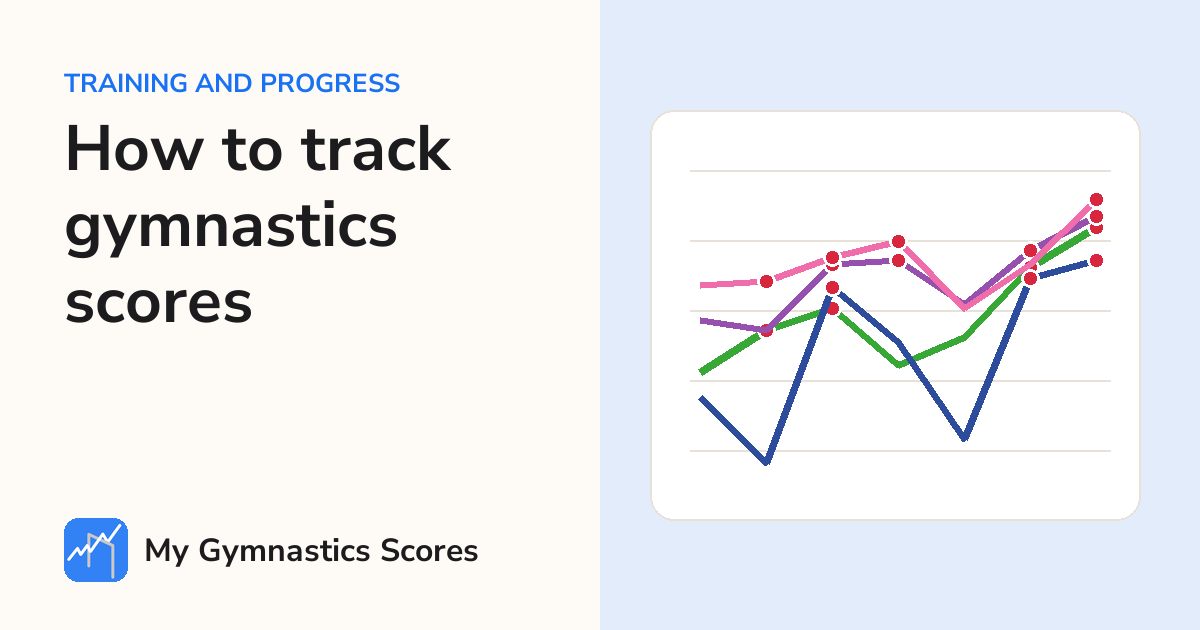
Mark each PB when it happens. A simple rule works well: a score is a PB if it is higher than every earlier score on that apparatus at that level. The first score at a new level is the starting point, not a PB. Some families highlight PBs in red on their score sheet; that is exactly what the My Gymnastics Scores app does.
How to see progress over a season
Look at each apparatus on its own. A gymnast can improve fast on floor while bars stay flat, and the all-around total hides that. A line graph with one line for each apparatus shows the pattern at a glance: which events are rising, which are steady, and which need work.
When you read the graph, look for the trend, not single points. One low score after a fall is normal. Three low scores in a row on the same apparatus is worth a chat with the coach.
Set goals that help
Research on sport goal setting points the same way as most good coaches. A 2022 review in the International Review of Sport and Exercise Psychology found that process goals, such as “stick my beam dismount”, gave much bigger gains in performance than outcome goals, such as “win the competition”.
So use your score record to choose process goals:
- If the E-score on beam is low because of wobbles, the goal might be a steady full turn in training.
- If floor scores drop at the end of the season, the goal might be stronger landings on the last tumbling pass.
Write the goal down and track the skill in a training journal. Our post on the gymnastics training journal shows how.
Paper, spreadsheet or app?
All three work. Choose the one you will keep up:
| Method | Good for | Watch out for |
|---|---|---|
| Paper notebook | Simple, no screen | Hard to see trends; easy to lose |
| Spreadsheet | Full control, graphs | Takes time to set up and keep tidy |
| App | Quick entry at the venue, PBs and graphs done for you | Pick one that lets you keep or delete your data |
My Gymnastics Scores is made for this job. You enter the score and place for each apparatus after each competition, and the app works out the total and marks each personal best in red. It also shows a colourful graph for each apparatus and gives you a spreadsheet of the complete record. You can delete your account and data at any time. See the FAQ for details.
Common questions
How do I work out an all-around score?
Add the scores of every apparatus at the same competition. In women’s artistic gymnastics that is four apparatus, and in men’s artistic gymnastics it is six. If an apparatus has no score, for example because the gymnast did not compete on it, there is no all-around total for that competition.
Should I record qualifications and finals separately?
Yes. Each round has its own score sheet, so record each one as its own entry, for example “State Championships qualifications” and “State Championships finals”. Your personal bests stay accurate that way.
How can I track my child’s gymnastics scores without extra work?
Pick one place and enter the scores the same day, while the score sheet is in your hand. An app that works out the totals and personal bests for you takes about a minute per competition.
Track your scores with My Gymnastics Scores
Enter the score and place for each apparatus after every competition. The app shows your personal bests in red and keeps a training journal for each apparatus. It is coming soon to iPhone and Android, free to start.
Sources
- Harkin, B. and others (2016), Does monitoring goal progress promote goal attainment? A meta-analysis of the experimental evidence, Psychological Bulletin, 142(2), 198 to 229. Summary by the American Psychological Association.
- Williamson, O. and others (2022), The performance and psychological effects of goal setting in sport: a systematic review and meta-analysis, International Review of Sport and Exercise Psychology.